|
|
A mature laser automation solution for steel structure manufacturing
|

|
| The H Beam + Plate Integrated Laser Cutting System is designed for enterprises that need to process both structural H-beams/sections and flat steel plates within the same production environment. It combines 3D laser cutting for profiles with flat-bed laser cutting for plates on a single platform or integrated production line, enabling flexible and highly efficient manufacturing for steel buildings, bridges, construction components, machinery manufacturing, and heavy structural parts.
|
|
|
| The key advantage of the “two-in-one” concept lies in true process integration. With H- beam and plate cutting performed within the same system, material transfer and repeated repositioning are significantly reduced, production rhythm becomes smoother, and the same precision standard is applied to both beams and plates, resulting in better assembly fit-up. Flexible switching between different order types supports multi-variety and small- batch production, while shared equipment and maintenance resources help lower investment and operating costs, achieving overall optimization in efficiency, quality, and cost structure.
|
|
|
|
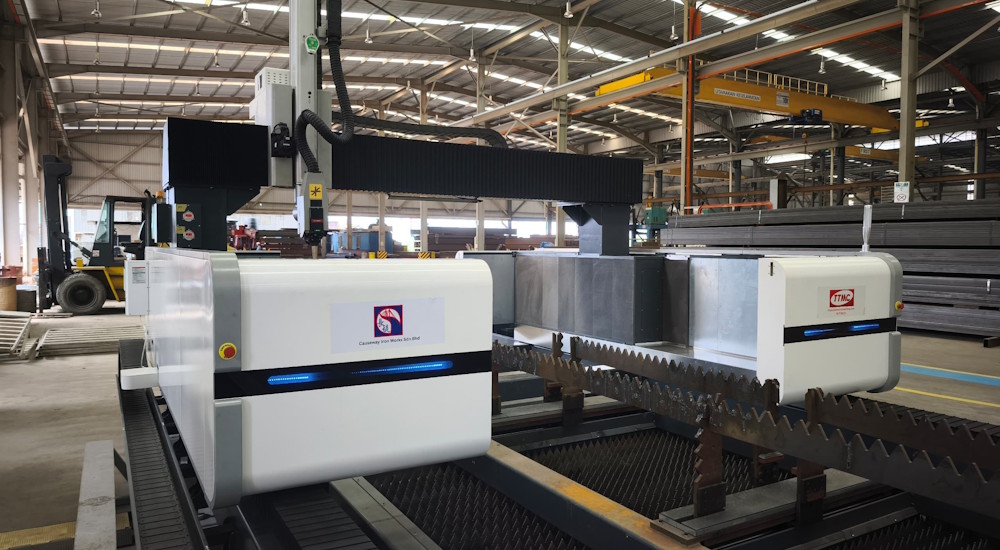
| In conventional workshops, H-beams and plates are processed separately on different machines. This leads to fragmented workflows, frequent crane or forklift handling, repeated alignment steps, and heavy dependence on skilled operators. By integrating both processes into one solution, this system maintains high dimensional accuracy while simplifying logistics, shortening processing routes, and improving overall productivity.
|
|
|
| For H-beams and structural sections such as I-beams, channels, and angles, the system supports web and flange openings, end cutting, bevel cutting, and complex contour processing, making it suitable for columns, beams, frames, and various engineering structures.
|
|
|
|
|
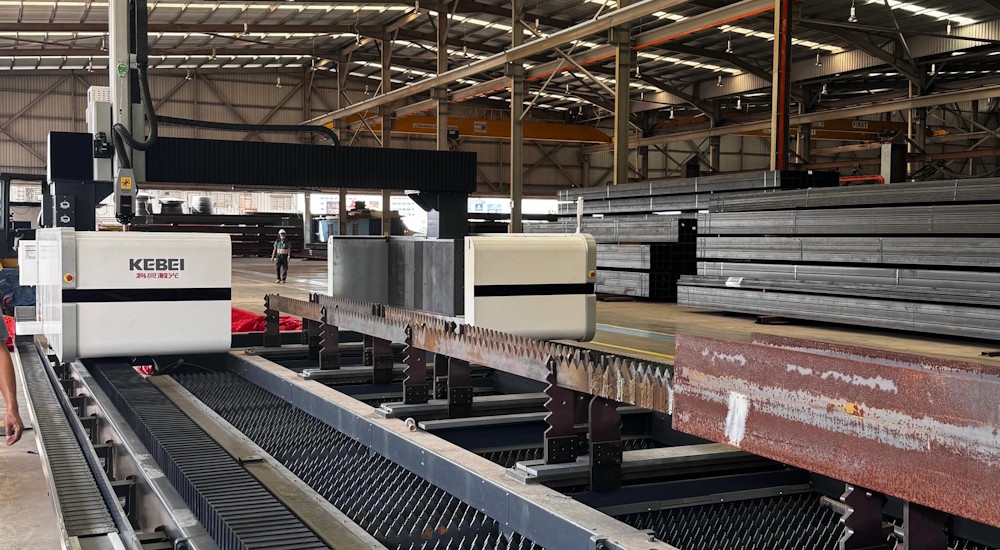
| For plate processing, the system acts as a high-precision flat-bed laser cutting platform capable of producing stiffeners, gussets, connection plates, node plates, cover plates, and customized shapes. Flat-plate laser cutting delivers high nesting efficiency, smooth edges, minimal heat deformation, and excellent repeatability, making it ideal for both mass production and flexible customized plate components. Intelligent nesting software increases material utilization, while high-speed laser cutting shortens production cycles and reduces secondary grinding and fitting work.
|
|
|
| Compared with plasma or flame cutting, laser cutting for both profiles and plates offers smaller heat-affected zones, lower distortion, finer cutting edges, and more accurate dimensions, directly supporting precise assembly and higher-quality welding. Cutting paths can be generated directly from imported CAD drawings, reducing reliance on manual pendant programming and making automation easier to implement on real-world production lines.
|
|
|
|
|
Typical Application Scenarios
|
|
|
Cutting of H-beams, columns,
and structural frames
|
|
|
| Production of stiffeners, gusset plates, connection plates, and node plates
|
|
|
Steel building and
bridge structure fabrication
|
|
|
|
|
Heavy machinery, shipbuilding,
and engineering structure manufacturing
|
|
|
Factories that must process both profiles
and plates within one flexible system
|
|
|
|
|
|
| TTMC designs welding and cutting automation systems with practical mass-production feasibility as the core principle. Rather than pursuing complexity for its own sake, TTMC helps customers choose the most appropriate technical solution based on real workpieces and production requirements. The focus is on ensuring stable operation in real industrial environments, supporting long-term continuous production, and preserving room for future capacity expansion and system upgrades.
|
|
|

|
TTMC Solution Philosophy:
Stable, Mass-Production Ready, and Built for Long-Term Use
|
|
|
|
|
|
|
|
|
|
Why Choose TTMC
|
| The Specialist for Welding, Cutting & Automation
|
|
|
.png "Expertise & Professional Services")
|
|
|
| Expertise & Professional Services
|
|
|
.png "Test")
|
|
|
Cost & Time
Effective
|
|
|
.png "Test")
|
|
|
Systematic
Management
|
|
|
.png "Test")
|
|
|
Value-Added
Services
|
|
|
|
|
|
Thank You for The Trust
|
| Our Successful Implementation for These Clients
|
|
|
|
|
|
|
|